Skip to main content

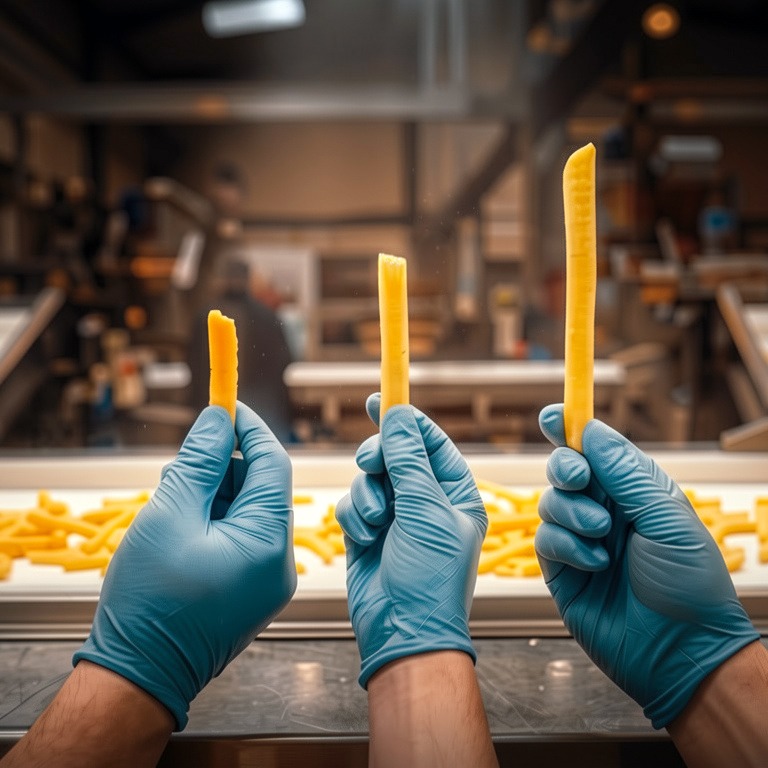
Fries that are too short or too long… Measuring them accurately may sound straightforward, but achieving reliable length control and measurement in an industrial processing line is a real challenge. Fries overlap, form clusters, and travel continuously on moving conveyor belts, making it difficult to determine their actual length with confidence.
This is where conventional measurement systems start to fall short. It’s time to move beyond traditional methods. Can artificial intelligence overcome these challenges? To find out, Optimum Sorting has integrated technology from AI partner Polysense into its software platform. These AI models can determine the true length of a fry far more accurately, even when fries overlap or are clustered together. The result is more reliable measurements, improved product quality, and greater efficiency throughout the sorting process.
Key insights:
The challenges of traditional length measurement
Conventional sorting systems evaluate products based on what their cameras can see in 2D. As soon as fries touch or overlap, there is a real risk of incorrect measurements. For example, a cluster of two overlapping fries is often interpreted as a single large fry. For processors supplying the retail or foodservice market with strict product specifications, these inaccuracies can become a real headache and create significant operational risks.
In many cases, processors lack a complete and objective view of the actual length distribution within a batch. As a result, it becomes difficult to accurately assess whether the product mix meets the required specifications. Quality control also becomes more challenging. Without detailed insight into length distribution, it is difficult to objectively verify whether a batch fully complies with agreed quality standards and customer requirements.
Inaccurate length measurements can also lead to unnecessary product loss. When too many long fries end up in a lower-value product mix, giveaway increases. Incorrect product classification may also result in fries being cut unnecessarily. The outcome is increased overprocessing, excessive product loss, and lower yields.

Three steps to smarter length control
To improve length control, Optimum Sorting developed the Sort-to-Length software module. In the future, this module will be further enhanced with advanced AI models developed by Polysense, a specialist in artificial intelligence for the food industry.
The process is straightforward. First, the desired length distribution is defined based on customer requirements, product specifications, or end-market needs. AI then measures the length of each individual fry with a high degree of accuracy, even when products overlap or form clusters. This provides processors with a continuous and objective view of the actual length distribution, enabling better process control, more accurate grading, and data-driven sorting decisions.



Achieving 100% length control with AI
Thanks to advanced segmentation algorithms, AI can see beyond complex product clusters. Even when fries touch, overlap, or are grouped together on the conveyor belt, the system can accurately identify and analyse each individual fry. Instead of relying on approximations, processors gain a clear and reliable view of the true length distribution across 100% of the product stream. To achieve this, the AI performs several analyses:

What does this mean for fry processors?
Artificial intelligence brings a new level of precision to fry length control. By analysing every individual fry in the product stream, it provides a complete and unbiased view of the true length distribution. As a result, processors gain greater control over product quality, raw material utilisation, and grading performance. Rather than relying on sampling or manual inspections, operators have access to continuous data from the entire product flow. This makes deviations easier to detect and enables faster, more targeted process adjustments.
The result is less product giveaway, reduced overprocessing, and a final product that consistently meets specification. The data also provides valuable insight into production performance, making it easier to compare yields, refine processing settings, and monitor line efficiency over time. In turn, quality control becomes more accurate, more predictable, and easier to manage.
Full insight into your batch
- Analysis of 100% of the product stream
- Complete visibility into the length distribution of every batch
- Objective quality data instead of manual sampling
- Faster detection of process deviations
Reduce waste, increase yield
- Improved raw material utilisation
- Less giveaway (fewer long fries ending up in a lower-value mix)
- Reduced overprocessing (less unnecessary recutting)
- More predictable margins
Greater product consistency
- Production according to customer specifications
- Reduced batch-to-batch variation
- More consistent product quality
- Data-driven decision-making
Shaping the future of potato processing with data
Through the partnership between Optimum Sorting and Polysense, processors can gain a much deeper understanding of their product flow. Where length control once relied on sampling and limited measurement data, AI now makes it possible to analyse every individual fry moving through the line.
“By combining Optimum Sorting’s vision technology with Polysense’s AI expertise, we can move beyond the limitations of traditional quality control. Length control is no longer based on estimates or assumptions. Instead, processors gain accurate, objective data on the true length distribution of their product stream. This helps them consistently meet customer specifications, reduce giveaway, improve raw material utilisation, and achieve more predictable product quality.” – Vincent Sonneville, Teamleader Area Sales Manager at Optimum Sorting

Interested in a free demo?
Get in touch with the sales team of Optimum Sorting and have your products tested at one of our demo centers around the globe.
Experience firsthand the benefits our machines can bring to your business!
Who is Polysense?
Based in Belgium, Polysense develops AI solutions for quality control and process optimisation in the food industry. By combining machine vision with real-time data analysis, the company continuously monitors product quality and production performance. These insights can then be used to optimise production processes and automatically adjust sorting systems, helping processors reduce waste and improve yield.