Skip to main content



What if a sorting system could detect defects that are virtually impossible for conventional cameras to distinguish? With A-EYE, Optimum Sorting introduces a new AI-powered sorting model built to tackle exactly that challenge. Combining artificial intelligence with years of expertise in optical sorting, A-EYE evaluates products in a completely new way, enabling more precise sorting decisions.
Tasks that were once difficult, or even impossible, to automate are now within reach for vegetable processors worldwide. Early applications are already showing promising results. In products such as green beans and leafy vegetables like spinach, A-EYE helps reduce food waste while delivering more consistent sorting quality. Want to know how A-EYE makes it possible? Discover how this new sorting model works and explore the results it can achieve in real-world processing environments.
Key insights:
Sorting the way humans see
To tackle complex detection challenges, Optimum Sorting developed A-EYE, a sorting model powered by Deep Learning. The name combines ‘artificial intelligence’ and ‘eye’, reflecting both the technology behind the model and the way it evaluates objects. According to Jan De Jonghe, CTO at Optimum Sorting, A-EYE doesn’t focus on a single characteristic. Instead, it assesses the entire object, much like the human eye. This ability to interpret visual information as a whole is what makes the model unique.
Unlike traditional sorting algorithms that rely on predefined rules, A-EYE learns from real-world training images. This allows products to be evaluated in a fundamentally different way. Instead of focusing on individual characteristics, A-EYE looks at the entire object, recognizing patterns in shapes, textures and visual details much like a human inspector would. By assessing all of this information together, the model can detect subtle differences that conventional camera-based sorting systems often struggle to identify. As a result, A-EYE can recognize complex defects with a much higher level of accuracy, including defects that were previously difficult or even impossible to detect reliably.
”Although A-EYE uses Deep Learning, human expertise remains essential. The model doesn't decide for itself what constitutes quality. Instead, it learns from the knowledge and experience of product specialists, operators and quality managers. During the training process, these experts define what should be accepted and what should be rejected. Their decisions form the basis of the model. A-EYE then learns to apply the same judgement consistently across large volumes and at sorting speeds that would be impossible to achieve manually.
Jan De JongheCTO Optimum Sorting

A new benchmark for vegetable sorting
The first A-EYE applications are now being introduced in the vegetable processing industry, where complex detection challenges are a daily reality. Some defects are nearly indistinguishable from good product, making them difficult to detect even with advanced sorting technology. That’s one of the reasons Optimum Sorting selected green beans as its first application. Known for defects that closely resemble good beans, this product stream presents a real challenge for sorting systems. It is precisely in these demanding applications that A-EYE demonstrates its value.
One well-known example is the stem end of a green bean. For conventional sorting systems, distinguishing it from the bean’s naturally pointed tip can be challenging, as the visual differences are often extremely subtle. Yet it is precisely these small details that determine whether a product is accepted or rejected.
A-EYE enables Optimum Sorting to recognize these characteristics far more accurately. The model is also trained to detect stems, twigs and other plant debris that can end up in the product stream during harvesting. Because these materials often closely resemble good beans, they have traditionally been difficult to separate reliably.
”Purslane is a perfect example of why we developed A-EYE. For traditional sorting systems, this plant has always been difficult to handle because, after harvesting, it can be almost impossible to distinguish from green beans. As a result, processors have often had no choice but to reject entire batches. With A-EYE, we can now determine far more accurately what belongs in the product stream and what doesn't. Beyond green beans, we are also developing applications for spinach. Several weed species that have traditionally challenged spinach growers can now be identified and removed with precision. This helps processors retain more saleable product, reduce food waste and maximize the value of every harvest.
Jan De JongheCTO Optimum Sorting
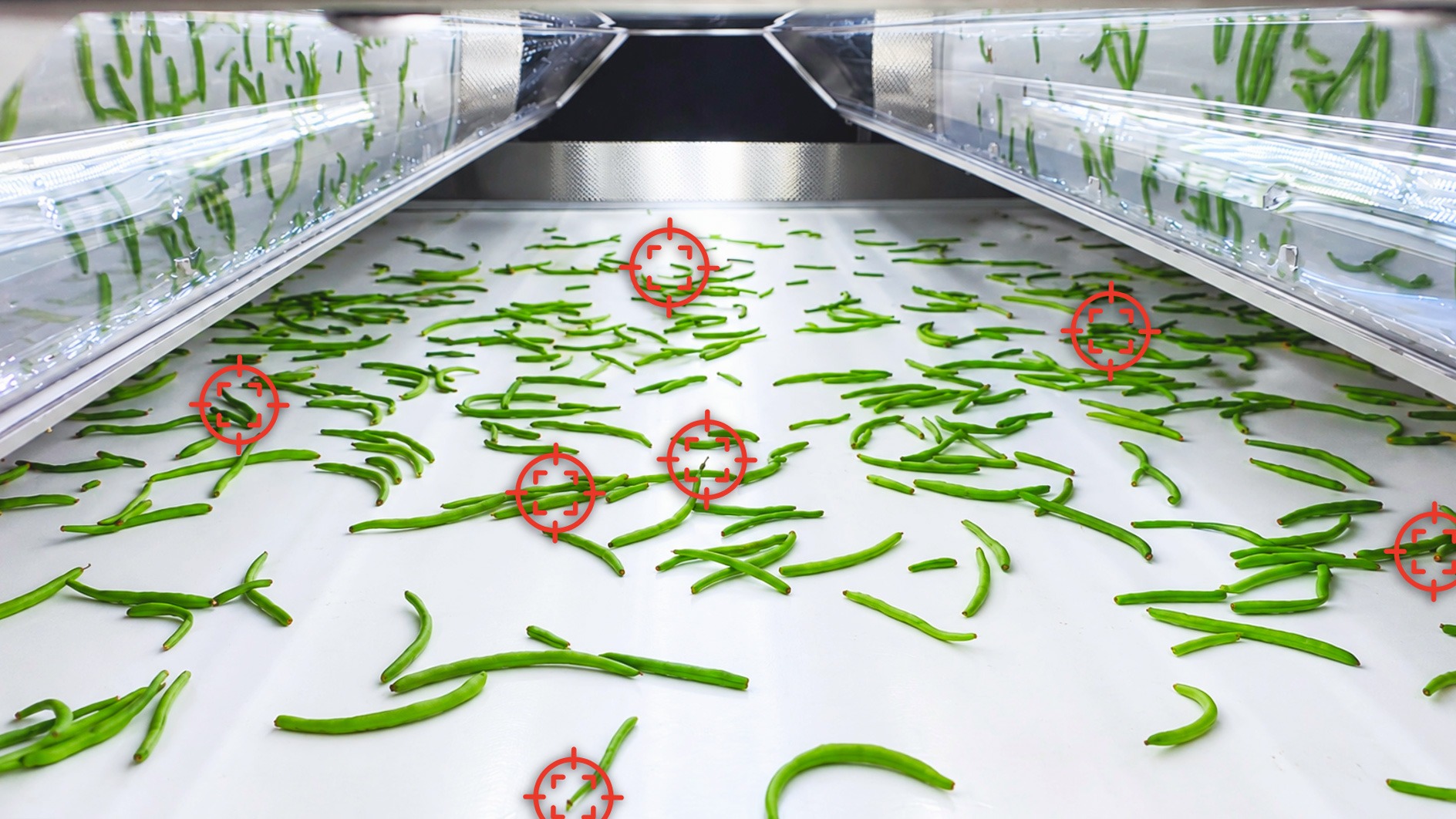
Green bean sorting on an Optimum Sorting Novus sorter
Improving quality, yield and capacity
A-EYE adds an additional detection layer to your existing sorting machine. Using artificial intelligence, it can identify unwanted material such as stems, weeds and other plant debris with a much higher level of accuracy, even when these materials are visually similar to the good product. This enables more reliable detection of complex defects in product streams such as green beans and spinach. The results are clear. In green bean applications, stem-end detection rates increased from approximately 70% to 97%. The outcome is a cleaner end product, higher product quality and greater confidence in every sorting decision.
Greater accuracy also leads directly to higher yield. The more precisely defects and foreign material are removed, the more good product remains in the process. This reduces unnecessary product loss and ensures that a larger portion of the harvest can be processed and sold. The result is a higher yield from every batch and less food waste throughout the production process.
A-EYE also opens up new possibilities for increasing sorting line capacity. Powered by artificial intelligence, the system can classify products reliably even when vegetables overlap on the conveyor belt. As a result, processors can run higher volumes while maintaining the level of sorting accuracy required to meet quality standards.
"With A-EYE, processors can sort up to +50% more product within the same time"
Higher quality
-
Accurately identify even the most difficult-to-distinguish defects and recover more value from every product stream, thanks to a more reliable separation of good product from complex defects.
Higher yield
- Increase yield from every batch by retaining more good product and reducing waste. As a result, a larger share of the product remains available for further processing or sale.
Higher capacity
-
Scale your sorting line capacity by up to 50% without compromising sorting quality, even at higher throughput rates.
Pushing the boundaries of sorting technology
Artificial intelligence and Deep Learning are set to play an increasingly important role in the vegetable processing industry. Beyond delivering higher detection accuracy, the technology also accelerates the development of new sorting applications. In the past, developing a new sorting model could take months. Today, new applications can build on the knowledge and datasets gained from existing models. As a result, new detection models can be developed, tested and optimized more quickly for specific products, defects and processing environments.
The true value of AI lies not in the technology itself, but in its ability to solve inspection challenges that were previously difficult to automate. For defects with highly subtle visual differences in particular, Deep Learning opens up new possibilities for reliable sorting. With A-EYE, Optimum Sorting is turning that vision into reality. The technology provides the foundation for a new generation of sorting applications that help processors achieve higher product quality, greater product recovery and more efficient production. With this development, Optimum Sorting is pushing the boundaries of what is possible in automated product inspection today and laying the groundwork for inspection applications that would have seemed out of reach just a few years ago.
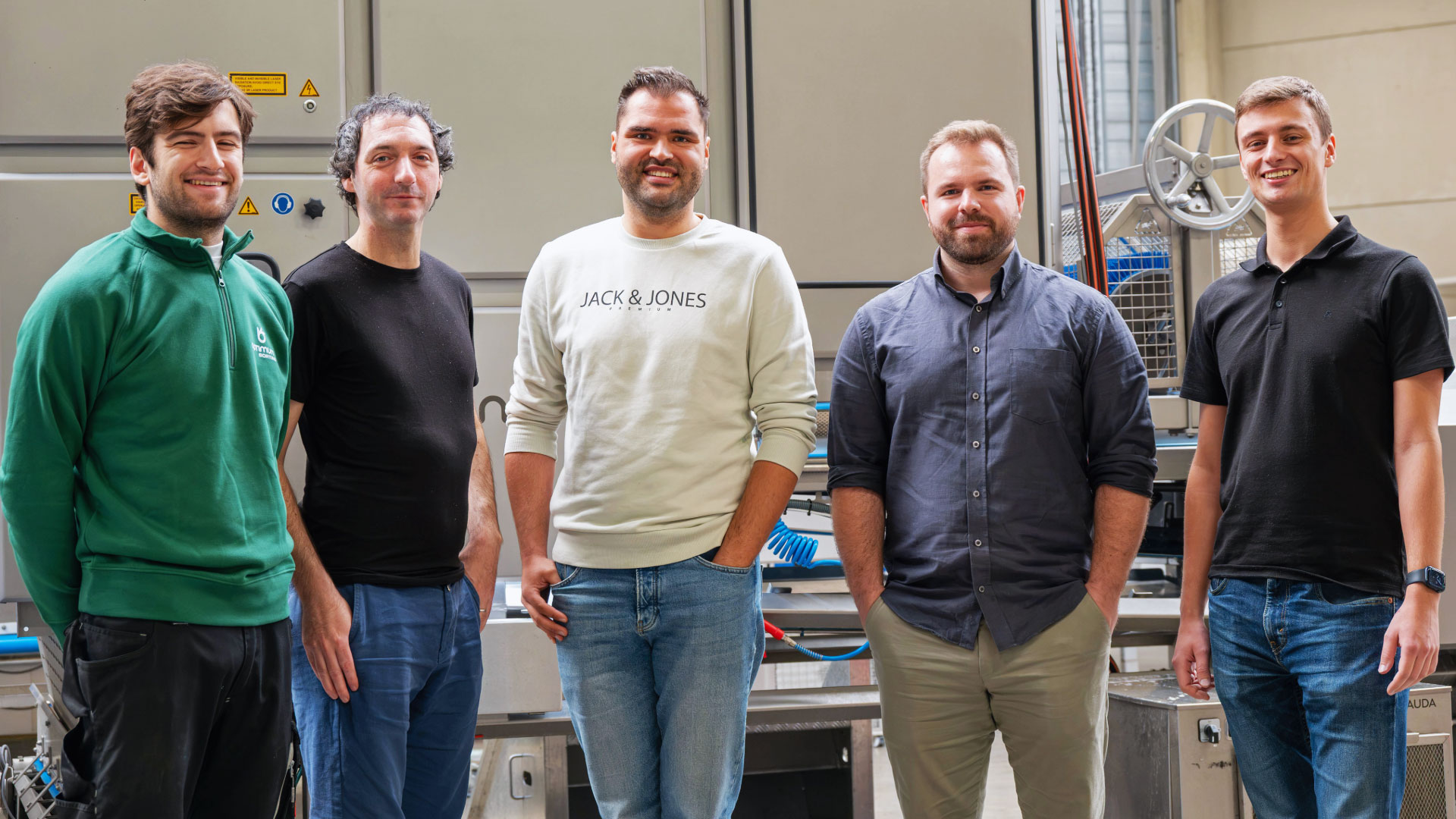
The A-EYE development team at Optimum Sorting
Interested in a free demo?
Get in touch with the sales team of Optimum Sorting and have your products tested at one of our demo centers around the globe.
Experience firsthand the benefits our machines can bring to your business!
Explore what A-EYE can do
From green beans to spinach, A-EYE is helping processors tackle complex sorting challenges. By taking a fundamentally different approach to product inspection, the model enables more reliable separation of defects and good product. Explore the possibilities of A-EYE and discover how it delivers more accurate sorting decisions.